
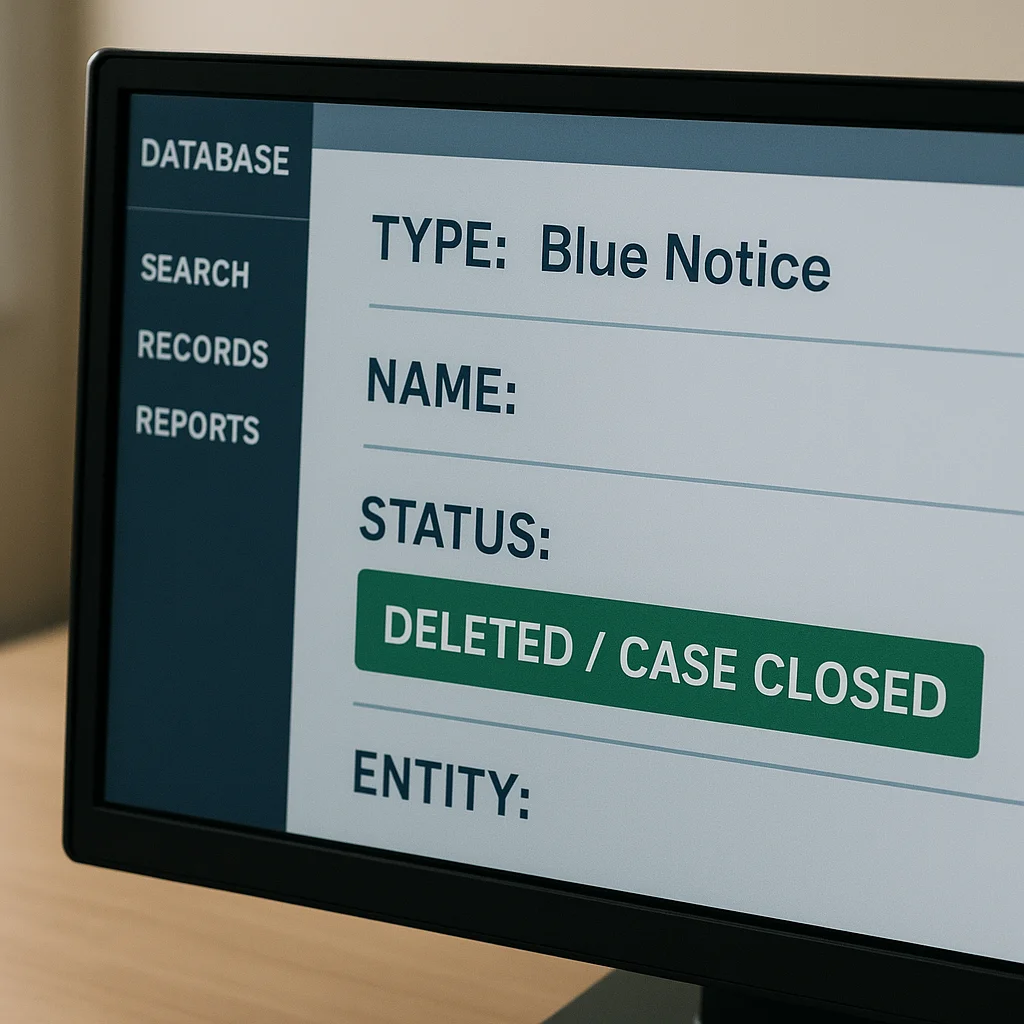
The main way to remove an INTERPOL Blue Notice is by petitioning the Commission for the Control of INTERPOL’s Files (CCF). It’s a formal legal gauntlet. The process starts by confirming the notice exists, then moves to a detailed argument showing that the notice breaks INTERPOL's own rules.
INTERPOL Blue Notice - A notice used by INTERPOL's member countries "to collect additional information about a person’s identity, location or activities in relation to a crime," as defined under INTERPOL’s Rules on the Processing of Data (RPD). Critically, it is an international request for information, not an international arrest warrant.
What is the Process for Removing an INTERPOL Blue Notice?
Challenging an INTERPOL Blue Notice is a formal, evidence-based process handled by an independent body within INTERPOL. It doesn't happen overnight. But there is a clear legal path to get a notice removed.
- Confirm the Notice: Your first move is filing a "Request for Access" with the Commission for the Control of INTERPOL’s Files (CCF). This is a simple question: is there a Blue Notice (or any other data) on me? The request forces INTERPOL to confirm its existence and provide details about its origin and purpose.
- Gather Evidence: Once confirmed, the real work begins. You and your legal counsel must build a case file. This isn't just about saying the notice is wrong; it's about proving it with court documents, evidence of political motives, or records showing the dispute is civil, not criminal.
- File a "Request for Deletion": This is a separate, comprehensive legal brief sent to the CCF. Here, you must argue precisely how the Blue Notice violates INTERPOL’s Constitution or its Rules on the Processing of Data (RPD). The most common arguments are that the case is politically motivated, it isn't a real crime, or the data is simply wrong.
- CCF Review: The CCF then reviews your submission. Be prepared for a long wait. The process often takes many months, as the Commission may need to go back and forth with the country that originally requested the notice (the National Central Bureau or NCB).
- Decision and Deletion: If the CCF sides with you, its decision is final and binding on INTERPOL. The General Secretariat must delete the Blue Notice from all of its databases. After that, all member countries are notified of the deletion.
What is an INTERPOL Blue Notice and Why is it Issued?
An INTERPOL Blue Notice is an international "request for additional information" about a person's identity, location, or activities tied to a criminal investigation. It’s a tool for police cooperation. It is not an arrest warrant like the infamous Red Notice.
When a member country's National Central Bureau (NCB) is investigating a crime and needs help from other nations, they can ask INTERPOL for a Blue Notice. This helps them locate persons of interest, identify witnesses, or trace a suspect’s travels. Its legal foundation is INTERPOL’s Rules on the Processing of Data (RPD), which defines its use for intelligence gathering.
Even though it's not an arrest warrant, a Blue Notice can cause serious problems. Your name gets flagged in law enforcement systems globally. This can trigger surveillance, intense questioning at borders, and difficulty opening bank accounts or getting visas. You can learn more about our work with INTERPOL matters and how these notices shatter normal life.
On What Grounds Can a Blue Notice Be Challenged and Removed?
A Blue Notice can only be deleted if you prove it fails to comply with INTERPOL's own legal framework. The burden of proof is entirely on you. The most effective arguments are:
- Violation of INTERPOL's Constitution: The single most powerful argument is a breach of Article 3. This article strictly forbids INTERPOL from engaging in activities of a "political, military, religious, or racial character." If a Blue Notice was issued to silence a political opponent, resolve a family squabble, or for discriminatory reasons, it is invalid. It must be deleted.
- Not an "Ordinary-Law Crime": A notice has to relate to a genuine criminal offense. If the underlying issue is a civil debt, a business contract dispute, or a minor regulatory issue, it likely fails to meet the "ordinary-law crime" threshold required for INTERPOL's involvement.
- Violation of Human Rights: If the notice comes from a criminal proceeding that fundamentally tramples human rights—like the right to a fair trial—it can be challenged. This argument often leans on international law principles and landmark cases from bodies like the European Court of Human Rights, such as Rotaru v. Romania, which dealt with the misuse of state intelligence files.
- Non-Compliance with Data Rules: INTERPOL’s own RPD mandates that data be accurate, relevant, and processed for a specific reason. If the information in the notice is outdated, just plain wrong, or no longer needed for the investigation, you have solid grounds to request its deletion.
Successfully arguing any of these points can lead to the notice's complete removal. It is important to read our guide on other INTERPOL Notices to understand the full context.
What Are the Different Types of INTERPOL Notices?
INTERPOL uses a colour-coded alert system, with each colour serving a specific function. The Red Notice for wanted persons gets all the attention, but several others are used daily by police worldwide.
What is an INTERPOL Blue Notice example?
Imagine a country is investigating a complex international fraud scheme. They believe a key witness, who may have information about the main perpetrators, has moved abroad but they don't know where. That country's NCB can request a Blue Notice. It asks police forces globally to report any sightings, known addresses, or travel details for this witness, helping investigators connect the dots.
Is there an INTERPOL Blue Notice list?
No. There is no public INTERPOL Blue Notice list or searchable database. Unlike a small fraction of Red Notices which are made public for high-profile fugitives, Blue Notices are confidential and strictly for law enforcement. The only official way to discover if you're on one is to file a formal Request for Access directly with the CCF.
What is a Black Notice from INTERPOL?
A Black Notice is issued to seek information about unidentified bodies. It circulates forensic details—like DNA, fingerprints, or dental records—and information about where the body was found. This allows police forces around the world to check against their own missing persons databases and hopefully give a name to the deceased.
What about a Green Notice, Orange Notice, or Yellow Notice?
- Green Notice: This is a warning. It’s about a person who has committed crimes and is considered a possible threat to public safety, often someone likely to re-offend in other countries.
- Orange Notice: Think of this as an imminent threat alert. It warns of an event, person, object, or process that poses a serious danger, such as a parcel bomb, a new weapon used by criminals, or a dangerous substance.
- Yellow Notice: A global alert to help find missing persons, especially minors. It can also help identify individuals who are unable to identify themselves, perhaps due to amnesia.
How Do I Submit a Request to the Commission for the Control of INTERPOL’s Files (CCF)?
Submitting a request to the CCF is a precise, formal procedure. Get it wrong, and your application won't even be considered.
First, all applications must go through the CCF's official online portal. As of 2026, the Commission no longer accepts submissions by post or email. You have to create an account and navigate their digital process.
Second, your request needs a clear, scanned copy of an official identity document, like a passport or national ID card. If a lawyer represents you, a signed Power of Attorney is mandatory. A common mistake is submitting a poor-quality scan or an expired ID, which can cause an immediate rejection and delay your case by weeks.
Finally, the entire application—arguments, evidence, everything—must be in one of INTERPOL's four official languages: English, French, Spanish, or Arabic. The legal arguments can't be vague; they must be detailed, reference specific facts, and cite the exact articles from INTERPOL's Constitution and RPD that the Blue Notice violates. This requires a firm grasp of the complex legal framework of international investigations.
⚠️ Time is critical — every day matters
Get a free case assessment
Our team specialises in cases with an international element. We review applicable treaties, assess risks, and prepare an action plan.
Facing an INTERPOL notice?
Get a free, confidential case review of your situation from experienced lawyers.
Request a free reviewFrequently asked questions
Can an INTERPOL Blue Notice be removed?
Yes — you can ask the CCF to correct or delete a Blue Notice that breaches INTERPOL's rules.
What are the grounds to challenge a Blue Notice?
Grounds include a political or unlawful purpose, human-rights concerns, lack of a proper basis, or data-protection failings under INTERPOL's rules.
How do I challenge a Blue Notice?
By filing a reasoned request with the Commission for the Control of INTERPOL's Files (CCF), usually with legal help.
Is a Blue Notice as serious as a Red Notice?
A Blue Notice gathers information rather than seeking arrest, but it can still affect travel, visas and banking.